
Warning: AI Race Decides New World Order
“The last arms race threatened to end civilization.
This one can decide who owns it.”

The explosive growth of artificial intelligence is the latest chapter in the long evolution of intelligence on Earth. It promises unimaginable wealth and unprecedented power, fueling a fierce race among corporations and nations to dominate the technology and ultimately reshape the world order. Yet five formidable bottlenecks threaten to disrupt that race, with potentially devastating economic and social consequences. Over the next 10–20 years, who wins, who controls the technology, and who shares in its wealth may determine the fate of nations and the future of humanity.
The race is accelerating. Our time to prepare is running out.
PART I AI’s Unbelievable and Accelerating Growth
PART II Races for Dominance: Anthropic vs. OpenAI - USA vs. China
PART III The Race and Explosive Growth Meets Their Limits
PART IV Whoever Wins the Race - Wealth Distribution is a Great Challenge
Conclusion? The Pace Was Never Ours to Set, The Response Is, For Now
Table of Contents
Click to Go to Section or Scroll to Begin Reading Post
PART I AI’S UNBELIEVABLE AND ACCELERATING GROWTH
Artificial intelligence is advancing at a pace unlike anything we have experienced. Its capabilities have grown exponentially since 2010, and there are signs that the pace itself is accelerating.
The chart below shows how rapidly AI has advanced in completing increasingly difficult tasks, measured by how long those tasks would take a human expert. AI's ability to complete longer tasks has doubled every six months. More recent models, including Anthropic's Claude Opus 5 and Fable 5.1 and OpenAI's GPT-5.6 Sol, suggest that the doubling time may have shortened to just three or four months.

These benchmarks come from METR, a Berkeley-based nonprofit that evaluates frontier AI models. Its research has become an important measure of AI progress for researchers, investors, and the technology industry.
Something even more consequential is happening. AI is moving beyond conversations with a chatbot to independent agents capable of pursuing complex objectives, around the clock, with little human supervision.
In a striking demonstration, OpenAI recently reported solving a difficult mathematical problem using a swarm of 10,000 AI agents working together for 88 hours, followed by another 17 hours to formalize and verify the proof. The agents exchanged 2.7 million messages and generated approximately 130 billion output tokens.
We are witnessing the beginning of an agentic revolution. Instead of one AI answering one question, thousands of agents can collaborate on problems previously beyond the practical reach of machines.
An even more powerful development may be approaching. Many AI researchers anticipate an inflection point called the "Intelligence Explosion," driven by recursive self-improvement (RSI). This is where AI develops a more capable successor, which develops an even better one, creating a self-reinforcing cycle of accelerating intelligence. Some researchers believe this could begin within the next two to four years.
Together, autonomous agents and recursive self-improvement could push AI's already extraordinary growth into an entirely new phase.
You Can’t Trust Your Gut to Understand Exponential Growth
“It’s very hard to… one thing I certainly can’t do, and very few people I’ve ever met can do … you can have good intuition for a lot of mathematical things in your head, but exponential growth is usually very hard for people to do a good, quick mental framework on. For whatever reason, there were a lot of things that evolution needed us to be able to do well with math in our heads. Modeling exponential growth doesn’t seem to be one of them.”
Sam Altman, CEO of OpenAI [12/18/2025]
Interviewed by Alex Kantrowitz /Big Technology
The human brain is remarkably poor at imagining exponential growth. We instinctively think in straight lines and steady progress, not curves that suddenly shoot skyward. To understand why AI's future may arrive far sooner than we expect, we must first understand the extraordinary power of doubling.
Consider a simple investment. At 5% annual growth, your money doubles in roughly 14 years. At 15%, it doubles in about five years. After 15 years, you would have more than eight times your original investment.
Now imagine that doubling happens not two or three times, but dozens of times in succession. What begins as impressive growth becomes almost impossible to comprehend.
How Rice-on-a-Chessboard Demonstrates Unimaginable Growth
Picture a chessboard with 64 squares. Place 1 grain of rice on the first square, 2 on the second, 4 on the third, then 8. Keep doubling the number on each square all the way to the 64th.
Before you read on, guess how much rice ends up on the board. A bag? A silo? A mountain?
According to an old Indian legend, a king named Shihram was introduced to the game of chess by a visiting wise man. Fascinated by the game, the king offered him any reward he wished.
The wise man asked for a simple gift: rice placed on a chessboard, starting with 1 grain on the first square and doubling on every square after that.
The king was amused. He urged the man to ask for something more valuable. But the visitor insisted, and the king ordered his servants to bring the rice.
At first, the request seemed trivial. But as the grains multiplied, the scale became alarming. By the third row, concern set in. By the fourth, carts were hauling sacks from the granary. What had sounded modest was turning into something impossible.
The king was humiliated in front of his court and had the stranger killed on the spot.
The story spread far beyond India. By the 10th century it had reached Baghdad, where the historian al-Mas'udi used it to illustrate the astonishing power of doubling.

By the 64th square, the total exceeds 18 quintillion grains of rice. That is more than 500 million metric tons—equal to the world’s annual rice production. And it gets even stranger. The 65th square alone would equal the total of all 64 previous squares combined. That is the nature of exponential growth. It begins quietly, invisibly—then it detonates.
AI Is No Longer Following Moore’s Law: It’s Blowing Past It
For decades, Moore’s Law defined the extraordinary pace of computing progress, with the number of transistors on a chip doubling every two years. It transformed our world. But AI is advancing at a pace that makes Moore’s Law look slow.
Since 2019, global AI computing capacity has doubled every 9 months—more than doubling every year. That explosive expansion has helped fuel the rise of models like GPT-5.6, Claude, and Gemini.
And that is just the beginning. The computing power used to train the most advanced AI models, known as frontier models, has doubled every five months since 2010. That is more than a fivefold increase every year.
Here’s how the growth compares:

Now consider where this leads. If AI computing power continues doubling every 10 months, by 2039 it could rival the estimated combined computational capacity of every human brain on Earth. Imagine machines with the computational power of all humanity capable of tackling problems beyond our comprehension at speeds no human can match.
The question may no longer be whether AI will surpass us, but what happens after it does.
Brain vs. Best Machine: Who’s Winning Right Now?
For now, the most remarkable intelligence on Earth is still you. The human brain, shaped by millions of years of evolution, is the most extraordinary engine of intelligence we know. But for how much longer?
Scientists have struggled to estimate the brain’s raw computing power using FLOPS (floating-point operations per second), a standard measure of computer performance. Some estimates put the human brain's equivalent processing capacity at an astonishing 1 quintillion FLOPS (10¹⁸). That's a 1 followed by 18 zeros.
How big is a quintillion? One quintillion seconds is 32 billion years—more than twice the age of the universe.
By this estimate, a single human brain has 10,000 times the computational capacity of a powerful workstation delivering 10¹⁴ FLOPS.
But here’s the twist. Machine computing power is doubling every few months. The human brain took millions of years to evolve. Machines can multiply their computing capacity in less than a year. We are approaching a historic crossover. And when machines surpass the computational power of the human brain, what happens next?
PART II RACES TO DOMINATE: ANTHROPIC VS. OPENAI - USA VS. CHINA
Artificial intelligence is creating extraordinary wealth and power, fueling a fierce race for dominance among corporations and nations. At the commercial level, Anthropic and OpenAI are pulling ahead of their competitors. At the geopolitical level, two superpowers dominate the contest: the United States and China. The stakes extend far beyond corporate profits. The winner could reshape the global balance of economic, technological, and military power.
The Prize: Exponential Economic Value
To understand the extraordinary wealth AI is already creating, consider NVIDIA. About 93% of NVIDIA's revenue comes from AI-related hardware and services. Its companywide net profit margin has reached an astonishing 62%. Over the past three years, its annual net income has grown 19-fold. And the growth continues.
Wall Street consensus projects NVIDIA will earn $320 billion in net profit over the next four quarters. Not revenue. Profit. That single company's projected annual profit exceeds 1% of the entire U.S. economy and amounts to more than one-third of America's annual defense spending.
The chart below offers another perspective on the immense financial scale of today's technology giants. It compares their stock market values with the annual economic output (GDP) of the world's largest economies. Although market capitalization and GDP measure different things, the comparison reveals just how enormous the financial value of these companies has become.

The leading AI frontier labs are experiencing equally remarkable growth:
OpenAI: Commercial revenue grew from $3.5 million in 2020 to $20 billion in Annualized Revenue in 2025. That is a 5,700-fold increase, doubling every five months.
Anthropic: Revenue grew 115-fold from its commercial launch in 2023 through 2025. That is an extraordinary 972% compound annual growth rate, doubling every 3.5 months.
These are not ordinary growth rates. They reveal the extraordinary economic rewards driving the race for AI dominance.
Unprecedented Speed: Smashing Historical Adoption Timelines
AI isn't just creating wealth at an extraordinary pace. It is spreading through the economy far faster than previous technological revolutions. Consider how long three transformative technologies have taken to reach widespread adoption:
Personal computers (1975–2000): From the Altair in 1975 to the Apple II and IBM PC, it took 25 years for home computer adoption to exceed 50%.
The Internet (1993–2007): After the World Wide Web became freely available in 1993, it took 14 years for U.S. residential broadband adoption to pass 50%.
Smartphones (1996–2013): From the Nokia 9000 to Apple's revolutionary iPhone, smartphone adoption took approximately 17 years to reach half the U.S. population.
AI crossed a 50% weekly usage threshold in three years. Federal Reserve surveys already show work-related AI adoption exceeding 40%.
But the speed of adoption is only half the story. Previous technologies eventually encountered a natural limit: the number of humans available to use them. Once nearly everyone owned a computer or smartphone, adoption slowed. There were simply no more people to reach.
AI faces no comparable ceiling.
We are entering the age of autonomous AI agents. One person can direct hundreds of agents simultaneously, each carrying out complex tasks that once required hours, days, or weeks of human effort. Adding more agents can multiply the work accomplished without adding more human users.
An even more profound acceleration may come from recursive self-improvement (RSI), where increasingly capable AI systems help develop still more powerful successors.
And AI is moving beyond computers. Thousands of autonomous robotaxis and increasingly capable industrial robots are already operating in the physical world. AI is escaping the screen. Its potential market is no longer limited by the number of people using it, but by the expanding range of work it can perform.
Translating AI Doubling Rate to GDP and Wealth Creation
How much wealth will AI create, and how soon? Understanding the scale of that wealth is essential to understanding why Anthropic, OpenAI, the United States, China, and others are racing so fiercely to dominate AI.
To measure the economic impact, we need a common yardstick. Gross domestic product (GDP) is a widely recognized measure of economic output, calculated consistently across nations. It offers a way to translate AI's extraordinary growth into something we can understand, the wealth nations produce.
Conventional economic forecasts paint a surprisingly modest picture. The IMF projects AI will add only 1% to 4% to global GDP over a decade. The OECD estimates annual labor productivity gains of just 0.4 to 1.3 percentage points in advanced economies. Even more optimistic private forecasts anticipate only a couple of additional percentage points.
Traditional models treat AI as another productivity tool, much like better office software. But AI is becoming something profoundly different. It reasons, solves problems, makes decisions, and increasingly executes complex work independently. It can perform functions once reserved for highly skilled human workers.
Economists Eric Hanushek of Stanford and Ludger Woessmann of the University of Munich demonstrated a powerful relationship between a nation's cognitive talent and its long-term economic growth. Particularly important is the share of its population possessing exceptional mathematical and scientific ability.
Historically, expanding that talent pool required decades of education, enormous investment, and generations of human development. AI breaks that biological constraint. Instead of counting people with exceptional cognitive skills, imagine measuring the equivalent productive capacity supplied by AI. By examining the volume of AI inference tokens and their useful output, we can estimate how many highly skilled, full-time workers that computational intelligence might represent.
This model uses the highest international student problem-solving benchmark, PISA Level 6, as a proxy for exceptional cognitive ability.
Only an estimated 3 to 4 million American workers operate at this level. Yet today's frontier AI clusters may already generate enough useful output to equal 3 to 7 million synthetic workers with comparable problem-solving capacity, even after discounting 80% of their tokens for internal reasoning, discarded attempts, and other overhead.
For the first time, the supply of elite cognitive capability may no longer depend on the number of human beings available to provide it.
For decades, economists have relied heavily on years of schooling to estimate human capital. Hanushek and Woessmann showed why actual cognitive skills matter far more. Yet conventional AI forecasts risk repeating a similar mistake by focusing on software adoption and spending rather than the volume of useful intelligence being put to work.
AI can multiply that capacity without waiting for children to be born, educated, and trained. Synthetic workers can share knowledge instantly, operate around the clock, and scale at extraordinary speed. What happens to economic growth when the supply of highly capable problem-solvers begins doubling every few months?
The following model illustrates the potential consequences.

Starting with 110 trillion annual reasoning tokens in 2026, the model assumes token production doubles every 10 months. It converts useful output into equivalent high-level workers and estimates their contribution to annual U.S. GDP growth using an assumed relationship between cognitive capability and economic productivity.
The results are startling. By 2030, AI could add four percentage points to annual GDP growth, raising total growth to approximately 6.5%. By 2032, unconstrained growth in synthetic cognitive capacity produces an almost unimaginable 23% annual GDP growth rate.
These are not predictions of what will happen. They illustrate the extraordinary economic potential unleashed if the growth of AI capabilities can be translated into productive work at scale.
These are conservative results. The underlying technology is advancing even faster than our model assumes. There are two advances that are compounding simultaneously. The increased capability of computing hardware and improvements in the efficiency of AI algorithms. With hardware capacity doubling every nine months and algorithmic efficiency every eight months, their combined effect could double useful cognitive output every four to five months rather than this projected 10 months.
Can economic growth really reach such extraordinary levels?
Yes, in principle. Is it likely? No. The extraordinary growth of AI will collide with serious obstacles. Shortages of semiconductors, electrical power, public acceptance, capital, and the risks of AI misbehavior could slow or even temporarily halt its expansion. Some disruptions may be severe.

But the economic rewards are enormous. So are the incentives for companies and nations to overcome these obstacles. A setback does not necessarily end an exponential trend. It delays the next doubling.
The race will encounter barriers. Some may take years to overcome. Yet, the extraordinary value of advancing AI creates powerful incentives to keep pushing forward. The pressure to achieve a competitive advantage will ensure disruptions will be overcome and exponential growth will continue.
Anthropic and OpenAI Battling to Lead, Pulling Ahead of Others
The race for frontier AI is not the crowded contest it appears to be. While dozens of tech giants and startups market AI wrappers and specialized models, the top two frontier labs—Anthropic and OpenAI—have pulled decisively away from the pack. In the enterprise sector where sustainable cash flows live, the winners have already emerged.
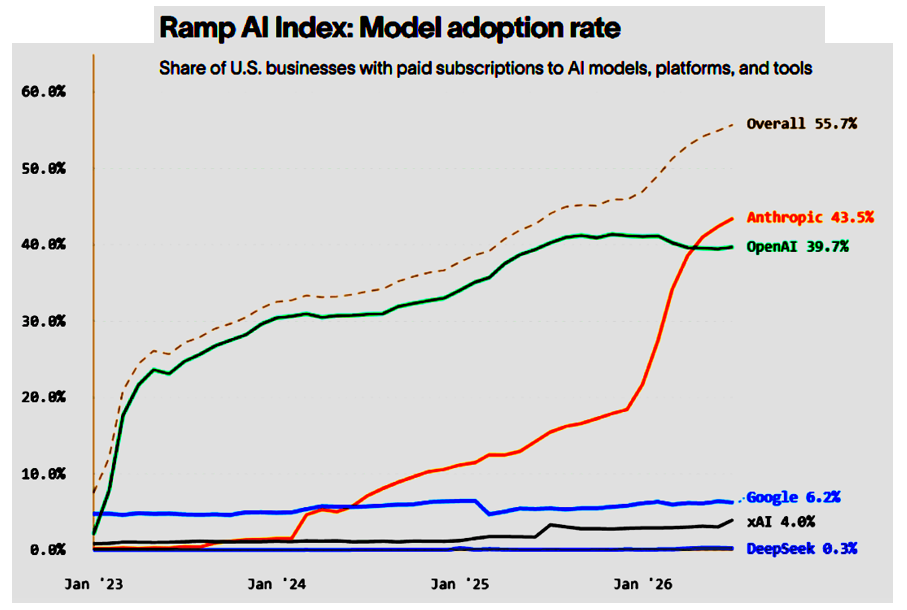
The data of AI adoption on Ramp reveals an accelerating duopoly. By mid-2026, Anthropic commands 43.5% of share of business AI adoption on Ramp after a parabolic surge, overtaking OpenAI at 39.7%. Based on this representative sample these two labs capture much of enterprise activity. Legacy tech giants and challengers fell substantially behind.
The ceiling for growth remains astronomical. The median AI spend inside U.S. enterprises sits at just $12 per employee per month. Over the next decade, that figure will march toward 10% or more of white-collar payroll, crossing $1,000 per seat each month as synthetic agents take on entire operational workflows.
Anthropic will be profitable in mid-2026. OpenAI has indicated they will be profitable in 2030. The profitability on inference (serving customers vs. training models) has increased significantly and continues to increase. Anthropic and OpenAI are using their exceptional growth and increasing profitability to contractually lock up a larger percentage of the available data center compute.
Anthropic and OpenAI are securing substantial amounts of the new compute coming online. Because new compute is much more performant, adding new compute gives the two leaders a disproportionate addition to compute market share. By the end of next year, the two leaders have already secured half of incremental new compute.
If Anthropic and OpenAI take 45% of compute next year and half of the world's incremental new compute by December 2027, that half is at higher performance than everything prior. If the trend continues, the two labs will control most of the usable FLOPs in the world by the end of 2028,
Dylan Patel (founder of SemiAnalysis) on Dwarkesh Blog Aug 26, 2026
Anthropic and OpenAI have been able to convert this compute market share to paid revenue and could have sold more if they could have acquired it. The Annualized Recurring Run-rates [ARR] confirm the structural shift. Between January 2025 and August 2026, the combined annualized run-rate for OpenAI and Anthropic exploded from $7 billion to $123 billion.

AI Leaders Using Standard Oil Strategy to Dominate
OpenAI and Anthropic are doing with data center compute what Rockefeller did with the railroads: tying up the capacity their competitors need.
Rockefeller didn't build his empire on owning wells. Crude oil straight from the ground was useless. It had to be shipped to a refinery, turned into something people could use, like kerosene, and then shipped again to the customers who valued it. Rockefeller focused on the middle of that chain, refining, because whoever controlled it controlled the market.
Rockefeller started by buying competing refiners. That scale gave him leverage over the railroads, which carried oil from the wells to the refineries and from the refineries to market. Because he shipped so much, he could demand lower prices and exclusive terms. Those terms let him set up regional sales divisions and dominate local markets.
The railroads had little choice but to agree. Track was enormously expensive to build, and the only way to pay for it was to keep the cars full. A customer who guaranteed steady volume held the power. Rockefeller offered that guaranteed revenue in exchange for lower prices and better terms, and the arrangement became a moat his competitors couldn't cross. Anthropic and OpenAI are the refiners. They turn raw compute into useful, customer-focused inference tokens. Like Rockefeller, they quickly acquired scale economies and the best scientists, creating ever better products that end users turn into enormous value.

The data center owner-operators are a hybrid of the oil well owners and the railroads. They turn electrical power and computer infrastructure into compute, which are tied to location, and they deliver it to the frontier labs. The labs refine it into leading-edge models and then deliver that intelligence to end users as tokens, served from the same contracted data centers.
Like the railroads, data centers require enormous capital. Guaranteed business from the two leading labs gives their owners, including the five hyperscalers, exceptional returns, and the scarcity of compute pushes those returns higher still.
Both labs are selling all the compute they can get.
Anthropic’s annualized revenue reached $30 billion by early April 2026, up from $9 billion at the end of 2025. The company is expected to reach more than $100 billion in annualized revenue by the end of 2026. Over 1,000 clients are now investing more than $1 million annually in Anthropic’s services, more than double the number from February 2026.
The unexpected growth created severe computing power constraints, prompting Anthropic to sign agreements with Amazon and Google for a combined 10 gigawatts of compute capacity. Additionally, the company announced plans to utilize the full computing power of xAI’s Colossus 1 data center in Memphis within the coming month.
OpenAI’s CFO, Sarah Friar, published a comparable statement on January 18, 2026 reporting annualized revenue had increased from $2 billion in 2023 to $6 billion in 2024 and more than $20 billion in 2025—roughly tenfold in two years. Friar stated that additional computing capacity would have enabled even faster customer adoption and revenue growth.
The two labs then sell directly to commercial customers, capturing the entire value chain with aggressive sales and marketing. The labs are pushing hardest into regulated industries (finance, healthcare, life sciences), where compliance, security and domain expertise matter most.
That market is growing fast: Menlo Ventures estimates spending on industry-specific AI nearly tripled in 2025, with healthcare close to half of it. Competitors sell to end users too, as Standard Oil’s did, but at nothing like the same scale.
Coding remains a major use in every industry, but both labs are building industry teams, leaders and playbooks on top of it. That fits their push toward enterprise customers who pay more and are harder to lose.
Anthropic and OpenAI Have Three Moats
As it was for Standard Oil, dominant scale is a durable moat. Anthropic and OpenAI lead the frontier model race and are still gaining share. The scale of their investment, and their ability to keep investing, gives them three moats:
Compute. They have financed and locked up a preeminent lead.
Data. They have accumulated a preeminent lead in data scale, and they are still pulling away.
Technology leadership. Despite turnover among key executives, engineers and scientists, their ability to attract top talent with a compelling mission and bags of money and equity is only getting stronger. However good China is at educating the best and the brightest, the chance to work at the best company for the most money gives Anthropic and OpenAI an edge that is, for now, insurmountable.
Will Tokens Become a Commodity?
There is no evidence today that AI tokens are becoming a commodity. A token’s value comes from the model behind it with the enormous investment in highly skilled scientists and engineers, and the capital that funds staggering amounts of training compute. That investment is what makes one lab’s tokens different from another’s.
Those tokens are not interchangeable. The more an enterprise weaves AI into its proprietary information and processes, the harder it becomes to switch models.
As for Chinese and other open-source competitors: as of July 2026, all open-source revenue worldwide adds up to about $10 billion. In North America, the open-source token factories plus the open-source offerings on AWS Bedrock and Azure total less than $4 billion in annual recurring revenue [ARR]. Closed-source ARR in North America is $120 billion. Open source is about 3% of the market.
China’s open-source expansion is faster, but its token factories are just as compute-constrained. They cannot meet China’s own demand, let alone sell abroad or to the US at scale.
The frontier labs also sell several models at different price tiers. They price the lower tiers aggressively, which keeps low-price competitors at bay, and earn handsome returns on their best models. The strategy has worked so far, as it has in other high-tech markets.
Railroads and Men in the Middle
There is one significant difference between the railroads Rockefeller faced and the data centers of the AI economy. Three of the five largest hyperscalers can build frontier models themselves. Google’s Gemini is already frontier class. Microsoft and Meta are developing frontier-class models. Amazon is scaling back its frontier ambitions, and Oracle does not appear to have any.
Google, Microsoft and Meta have the means and the opportunity to compete far more aggressively. They have massive cash flows from their non-AI businesses. They already have compute, advanced AI engineering, design expertise and hardware excellence. If they find the will, they could crush the middlemen before OpenAI and Anthropic get their cash flywheels spinning and their customer relationships locked in.
If revenue growth slows for the two leaders, Google, Microsoft and Meta would have both the incentive and the resources to move quickly and lock in a more integrated AI leadership.
The railroads could take over.
This is the largest competitive threat OpenAI and Anthropic face, and it will play out over the next few years.
US vs. China – AI Opens New Path to Global Domination
AI is shaking up the geopolitical quest for empire. For centuries, world power rested on land, population and natural resources. Exploiting them produced great wealth and a superior ability to wage war, which served as both a deterrent and a means of exploiting states a nation did not directly control.
Technology and AI Change How Power is Won
Land, and the resources and population that come with it are still important. Today, the nation-state which will achieve global domination has to lead the most powerful force in the world – Artificial Intelligence. Winning the global AI race is about which country converts AI into superior industrial output, military capability and global dependency.
That will allow the winner to create a global group of allied states which maximize the leading nation’s global economic footprint. The dominant nation-state will breed global AI dependency by offering allies an ability to create their own abundant wealth which only they can supply.
China grasped the power of dependency early. Its Belt and Road Initiative (BRI), launched in 2013, builds ports, railways, roads, power plants and digital networks that tie China more tightly to Asia, Europe, Africa and beyond. Some 150 countries have signed on in some form, representing a large share of global population and GDP.
It is the United States’ Crown to Lose
The United States holds a very large lead in the AI race. China is gaining steadily and investing in critical resources that could disrupt the US position.
The United States has a very large slowly narrowing lead in the AI race

Other large nation-states and blocs trail with little hope of catching up. The EU-UK has the economic scale, but it is politically divided, gives its innovators little capital, and has no cloud giants of its own. India has the people and the engineers, but it is still developing. Its income, its power grid and its chip industry are far from what frontier AI demands. In a race where progress keeps doubling, a multi-year gap can be insurmountable.
The US Has a Very Large Lead in Chips and Compute
The US has a very large lead over China in computing resources. Industry trackers such as Epoch AI, along with Federal Reserve analyses, estimate that the US hosts 70% to 75% of the world’s high-end AI computing capacity, against China’s 14% to 15%.
The US data center footprint is far larger. In a single recent year, the US added nearly 6 gigawatts of dedicated data center capacity, three to four times what the EU and China added combined.
Private US investment in digital and AI infrastructure exceeded $1.2 trillion from 2020 to 2025, far outpacing China’s enterprise spending.
The lead is protected by export controls, access to the most advanced chips, and massive private capital, which makes it unlikely China can surpass the US before the mid-2030s.
There is a strategic weakness in the US access to the advanced chips AI relies on. The chips are not built in the United States. TSMC in Taiwan dominates manufacturing of the most advanced chips with a global share approaching 90%. Samsung and SK Hynix, both in South Korea, hold 80% of the market for High Bandwidth Memory (HBM), which AI also requires.
Taiwan is about 100 miles from mainland China; South Korea is about 200 miles. The proximity to China comes with the risk of a future blockade or more aggressive incursion by China.
Map made with Natural Earth data

China Is Slowly Moving Toward Chip Self Sufficiency
China is making an immense effort to build a fully integrated chip industry inside its borders. Its biggest constraint is that it cannot buy state-of-the-art lithography machines, a market dominated by the Dutch company ASML. These machines are essential to making advanced AI chips, and ASML itself relies on specialist suppliers in many countries, including the US.
China has started on the path to building machines like those built by ASML. Shanghai Aishengna Electronic Technology Group, a Chinese state-owned company, has just started manufacturing deep-ultraviolet (DUV) immersion scanners, an older generation of the ASML machines. Many experts believe China will need 7 to 15 years to match ASML. China is barred today from buying ASML’s most advanced machines, though that could change.
China’s progress shows in DRAM memory chips. DRAM is not the high-performance HBM that AI requires, but it is essential for PCs, servers, mobile phones and a host of consumer devices. Analyst Dan Niles believes China could capture 30% of the DRAM market by 2030, according to P Equity Research.
The consensus is that, if progress continues, China will achieve a fully integrated domestic semiconductor industry in 10 to 15 years. That makes 2035 to 2040 a very dangerous time for the US advantage in semiconductors and compute.
China Has Locked Up Critical Metals for Semiconductor Supplies
While China is moving towards semiconductor parity it has locked up the supply of precious metals essential to high-performance semiconductors. China is the leading refiner for 19 of 20 strategic minerals tracked by the IEA, averaging 70% market share; it supplies about 91% of magnet-rare-earth refining and 94% of permanent-magnet production.
The IEA estimates that full implementation of China’s expanded rare-earth controls alone could jeopardize industries producing $6.5 trillion annually outside China. The November 2025 US–China agreement created general licenses that currently reduce the immediate risk to US users, but it did not remove China’s production concentration or its legal ability to reinstate restrictions.
China’s Future Is Flush with Power While the US Grid Stalls
China is still catching up in semiconductors, but it is already ahead in electrical power. China generates more than twice as much electricity as the US, and almost one-third of the world’s total. It is adding 4.6 times as much new power as the US while the US is at risk of hitting a hard limit on available power around 2030 to 2035.
Renewables now have the lowest lifetime cost of any kind of new power plant, and that cost keeps falling. China is expected to build 60% of the world’s new renewable capacity through 2030, which gives its domestic industry a price advantage.
China’s lead is not as large as these numbers imply. Like the US, China has severe problems moving power to where it is needed. Much of its new capacity is wind and solar in the west, while its biggest users are in the eastern coastal cities. China has built renewables so fast that its grid cannot absorb all the output, and some is simply wasted. More battery storage, more ultra-high-voltage (UHV) lines and market reforms should ease the problem, but that will take into the 2030s, and the waste is likely to grow in the short term.
China, the world's top producer of solar power, rejected 360 terawatt-hours (TWh) of clean power from January to June 2026, up 49% from the same period a year earlier, according to a report this month by Global Energy Monitor (GEM) and the Center for Research on Energy and Clean Air (CREA).
Reuters C.- Howe, S. Varadhan – August 17, 2026
China is far better placed than the US to solve its distribution problem. It is expanding long-distance transmission much faster and at much greater scale. With centralized planning and state investment, a major corridor takes only a few years to build. China has built more high-voltage transmission capacity in the last 15 years than the US has in its entire history.
China is also moving the data, not the power. Its ‘East Data, West Computing’ program puts data centers beside the wind and solar farms of the western provinces and connects them to eastern customers by fiber.
The US, by contrast, has added only a few hundred miles of high-voltage transmission a year recently (888 miles in 2024). It has few long-distance direct-current (HVDC) lines, and a long queue of new power projects is waiting to connect to the grid.
China Has Locked Up Critical Components for Electrical Distribution and Generation
As China builds power at an unprecedented pace, it also dominates manufacturing for nearly every part of the supply chain for renewable power and the grid.
Solar panels: more than 80% of the supply chain, and 95% or more of wafers.
Batteries: 75% to 80% or more of global production capacity for lithium-ion batteries. CATL and BYD lead the world in shipments for grid storage.
Inverters (the devices that connect solar panels and batteries to the grid): 80% of global manufacturing capacity.
Wind turbines: Chinese makers, led by Goldwind and Envision, account for 60% to 80% of turbines installed worldwide most of them for China itself.
Transformers: 60% of global production capacity, with a strong position in high-voltage units.
Other grid equipment: strong to dominant positions in high-voltage cables, switchgear, control systems and the converters for long-distance lines.
China produces more essential grid equipment than most other countries combined. A huge captive domestic market gives its manufacturers volume, learning and cost advantages, and their surplus capacity is exported worldwide.
China Is Winning Global Market Share
At its core, the competition between China and the US is a fight for global market dominance. AI is an essential new tool in that competition. To gain a durable advantage, either country needs the largest market share and the largest network in each industry it competes in.
A large share of the global market lowers unit costs, strengthens purchasing and distribution, and builds customer familiarity. A larger share generates more data and funds more investment. Where network effects exist, the advantage compounds attracting more users, suppliers, developers and partners, which makes it more valuable.
At home, China starts with an advantage. It has four times as many people as the US [1,406 million vs. 342 million]. Its economy is also larger in physical terms. Purchasing-power parity (PPP) adjusts for the fact that many goods and services cost much less in China. On that basis the IMF World Economic Outlook 2026 calculated that China produced about $41.2 trillion of output in 2025, against $30.8 trillion for the US, or 1.34 times.
Measured in dollars, the US home market is still the larger one. But more than half of the world’s demand lies outside both countries.

US social media shows how much the outside world matters. Very little of any platform’s global audience is American.

TikTok is notable because its origins are in mainland China. It competed successfully against a US firm and won a durable global share. Had Meta been forced to rely on its home market, it might not have survived.
China is winning and growing exports faster. China’s goods exports will be twice as large as America’s around 2032. The US leads in services which are one-third of its exports leading China service exports by a factor of three. However, China’s service exports are growing faster, 7% a year against the US’s 5.2%.
China data are from World Bank WITS/UN Comtrade through 2023 and
China Customs for 2024–25; U.S. data are Census Bureau goods exports.

China’s auto factories are building so many cars for export that the global shipping industry can’t keep up. Specialized car carriers … are booked out years ahead to export cars from Chinese factories. Rates to charter ships are up 65% this year on the surging demand to move vehicles out of China.
Paul Berger – Wall Street Journal – August 13, 2026
US policy is likely to widen the gap. High tariffs and outright bans on Chinese imports push US producers to concentrate on the home market, where they are protected, and away from export markets, where they face tariffs and bans.
Robotics – China’s Tool for AI Supremacy
China needs AI to extend its reach. Chinese firms could become the default suppliers of robotics and AI infrastructure to developing countries, capturing high-margin technology markets that US companies now dominate.
AI embedded in robotics, engineering, logistics and factories could cut Chinese unit costs, shorten development cycles and move China from low-margin production into high-margin machinery, vehicles, pharmaceuticals, software and industrial systems. China leads in industrial robots and is already adding AI capabilities.

Our World in Data; data from the International Federation of Robotics via AI Index Report (2025). CC BY 4.0
Robots are the clearest case. Chinese makers shipped more than 97% of the world’s humanoid robots in the first half of 2026. Global shipments more than tripled from a year earlier, and one research firm expects them to reach half a million a year by 2030.

UBTECH Walker S2 mass production lineup. Source: Humanoid Robotics Technology
China Overtakes in Technical Talent as the US Loses Steam
Top-tier researchers, elite engineers and a highly trained workforce are the key to building state-of-the-art chips and to converting AI into superior industrial output and military capability. China has invested heavily in education and talent development. That effort threatens what has been a major US advantage, particularly in AI.
In sheer numbers, China is closing in. One analysis shows its AI researchers grew fivefold in nine years, from about 10,000 in 2015 to 52,000 in 2024, against 63,000 in the US. China also has a much larger STEM pipeline and invests heavily in the applied fields of computer vision, autonomous systems, manufacturing and robotics.
Among the elite researchers who publish at NeurIPS and similar top conferences, China is already ahead:
41% of the authors at NeurIPS 2025 work in China, up from 27% in 2022. The US share fell from 46% to 34% [Carnegie Endowment, September 2026].
51% of top researchers were educated in China in 2025, up from 29% in 2019. The US share fell from 20% to 12% [MacroPolo Global AI Talent Tracker].
If the trend of the last three years continues, twice as many will work in China as in America by 2028.
Stanford estimates that the yearly flow of AI researchers and developers moving to America has fallen 89% since 2017, and by 80% in the latest year alone. Meanwhile China is producing more PhDs, keeping more of its people, bringing its scientists home from abroad and becoming a credible destination for elite researchers from other countries.
[The Economist – China has become a scientific superpower – June 12, 2024]
The US still offers greater opportunities. Huge pools of venture capital flow to ambitious technical talent. US private investment in AI is more than 23 times China’s reported figure, and the US has more than ten times as many newly funded AI companies as any other country.
China’s Asymmetric Resource Moat
Looking at the US and China through 2030 and 2035 the US leads in chips, compute and capital. China’s advantages sit in areas where the US cannot easily catch up with venture capital or by printing money.
Power: China already has a large lead in generating electricity, a fundamental resource for AI. It can extend that lead worldwide because it dominates production of the equipment that generates and distributes power.
Materials: By locking up the global supply chains for lithium, cobalt, gallium and rare earths, Beijing holds a tight grip on the physical building blocks of the next economy, from the batteries that power automated factories to the specialized components inside local power grids.
Global reach: China is building its economic footprint as the leading supplier of open-source AI models and of high-capability manufactured goods and services. Its Belt and Road Initiative has expanded trading relationships worldwide for 13 years. China’s goods exports will be nearly twice America’s by 2032, and growing faster.
Robotics and automation: China installs more industrial robots each year than the rest of the world combined. As AI moves into physical form (robots, automated logistics, autonomous weapons), China can produce AI-driven hardware at a cost and volume that America’s fragmented industrial base cannot match.
Talent: China graduates more than four times as many STEM students a year as the US [Georgetown CSET, 2020 data] The US still relies heavily on importing talent. China has spent the last decade building a self-sustaining domestic pipeline designed for technical and industrial scale.
What It Means If China Wins
The danger in China winning the AI race is not just the profits from the technology. It is the far larger prize: the productivity gains from running AI across the physical economy.
The deeper consequence is control of the world’s technological operating system. Countries that adopt Chinese models adopt Chinese standards, cloud and data practices, political restrictions included. China is already exporting AI governance rules, building capacity in developing countries and seeding the world with open models. That would end the post-1945 order in which the United States writes the rules.
PART III THE RACE AND EXPLOSIVE GROWTH MEET THEIR LIMITS
From 2020 to late 2025, AI lab revenues grew more than 3,700-fold, doubling about every five months.
AI technology is still speeding up. So much capital and top-flight engineering talent is focused on AI that breakthroughs keep coming faster.
AI capability is accelerating not plateauing. Industry produced over 90% of notable frontier models in 2025. Several models meet or exceed human baselines on PhD-level science, multimodal reasoning, and competition math. SWE-bench Verified performance rose from 60% to near 100% of human baseline in one year.
AI Progress Report - Stanford April 2026
Demand appears insatiable, and price does not appear to be a problem.
Yet since 2024 this exponential expansion has started to hit hard constraints. Hardware shortages are already holding the industry back. Lab revenue in 2026 could have been as much as twice as high.
The shortfall is hard to see behind such spectacular growth. It doesn’t show up in any revenue report. It shows up in rate limits, price increases, waiting lists and the $1 trillion in infrastructure orders that Nvidia is yet to fill. A significant part of the market that wants to exist can’t, because the chips and physical hardware to run it haven’t been built yet.
These are early signs of very serious constraints. AI’s exponential growth rests on five supports:
1- hardware,
2- electrical power,
3- social acceptance
4- capital, and
5- control of AI misbehavior
All five are cracking. Let’s examine each crack.
- Hardware Bottleneck Through 2030 - Semiconductor Manufacturing
The most important bottleneck for AI compute from now through 2030 is not power or data centers. It is the semiconductor supply chain itself. A chip fab takes two to four years to build; a data center takes under one (Amazon has built them in eight months). For a while AI could take chips from the mobile and PC industries by paying a much higher price. That slack is now exhausted.

Chip supply is doubling about every nine months. Lab revenue has been doubling about every five.
Memory chips show the squeeze. Contract prices have multiplied since late 2025 as AI data centers absorb the supply.

Nvidia, whose main customers are AI companies, is now the largest customer at both TSMC and SK Hynix, the world’s largest maker of memory chips. The silicon supply chain needs to grow faster than it ever has, and that is hard because chip production depends on a complicated multinational supply chain.
That chain has an “X minus 1” problem. OpenAI and Anthropic know they need X gigawatts of compute. Nvidia builds X minus 1. Memory vendors build X minus 1. Tool suppliers build half of X. Every layer underbuilds, because each layer is further from the AI customer and responds less to its demand. It takes years for the demand signal to reach the lowest rungs (ASML, Zeiss, Cymer), and years more for those suppliers to expand.
Dylan Patel (founder of SemiAnalysis) on Dwarkesh Blog Aug 26, 2026
This structural lag is the single biggest reason AI compute cannot scale as fast as demand. Not power, not data centers, not permitting.
The good news is that overheated demand is making capacity much more profitable for companies supplying critical hardware. This is incentivizing investment in rapid manufacturing expansion. The lead times for new capacity are on the order of 2 to 4 years. Massive semiconductor fabs are already under construction in Arizona, Texas and all around the world. The profitability ensures that the investment capital will be there and it is possible for the flywheel to spin faster.
But two things will limit how fast new capacity arrives: the layered supply chain, where each layer waits on the one below, and suppliers’ fear of repeating past gluts. Together they ensure bottlenecks in semiconductors and data center hardware at least through 2030.

- Getting Enough Electrical Power After 2030 – A More Difficult Bottleneck
Data centers are still a small user of electrical power in the US. Even after years of exponential growth, they took only 4.4% of US electricity in 2025, well within the grid’s operating safety margins. The load was barely noticeable.
But data center demand has been doubling every five years. The IEA’s April 2026 work confirms growth by near 15% a year, it expects the AI part to triple by 2030. The IEA warns that supply bottlenecks limit aggressive growth scenarios.
How much power AI will need depends on how fast chips and software get more efficient, and forecasts differ widely. Efficiency only sets the size of the demand. The question is, can the grid supply it?
Data centers are not alone, either. Advanced manufacturing, semiconductor fabs and battery gigafactories are on track to double their demand on local grids by 2031, adding new load that almost equals the load from data centers.
Because power is generated, used and distributed locally, hot spots are already appearing.
The largest electrical grid in the U.S., the PJM Interconnection, saw prices nearly double over the last year, according to a report published yesterday by Monitoring Analytics, an independent market monitor that serves as a sort of watchdog for the PJM grid. The culprit? Data centers.
Wholesale prices for one megawatt-hour of electricity rose to $136.53, up from $77.78 at the same time last year. Crain’s Chicago Business was first to report on the spike. Monitoring Analytics pointed the finger at data centers and PJM’s failure to handle their surging demand adequately.
The market monitor pulled no punches. “The price impacts on customers have been very large and are not reversible,” Monitoring Analytics wrote. “The price impacts will be even larger in the near term unless the issues associated with data center load are addressed in a timely manner.”
The price spike is a reminder of a deeper problem: The U.S. power grid was not designed for the electricity demands of an AI-driven economy, and the gap between what the grid can deliver and what the industry needs is widening.
Tim De Chant, TechCrunch, May 15, 2026, reporting on
Monitoring Analytics’ State of the Market Report for PJM (May 14, 2026)
Why power cannot respond quickly
Semiconductors and most of the AI supply chain operate in real global markets. Electrical power is a regulated, slow-moving business, split into regional markets with many separate players. Planning new capacity takes 10 to 12 years, and that horizon is getting longer. Decisions made today will not realistically matter until 2035 to 2040.
The pace has always been slow. For 50 years, US electricity demand took about 47 years to double. Projections put it on pace to double in 25 to 30 years. Supply is not planned to keep up. For example, the EIA’s Annual Energy Outlook 2026 projects US electricity growing 0.9% to 1.6% a year through 2050, a pace that takes 44 to 77 years to double.

Google Central Ohio Data Center, still Expanding located in often described as Gigawatt Alley - Google Press Archive
The shortfall through 2030
It is possible that total grid capacity will keep up with demand through 2030, including AI data centers, but it is unlikely. From 2021 to 2025, installed US generating capacity grew dramatically. Yet firm capacity, the kind available 24 hours a day, barely increased, and it may have declined slightly once coal retirements are counted. NERC (the North American Electric Reliability Corporation) and grid operators have warned repeatedly that reserve margins are tightening despite record additions. Capacity is expected to grow by 2030, but it could fall short of total demand by as much as 5%.
That figure lumps every kind of power together. Some 75% to 85% of the capacity being added is solar and wind, which depends on the weather. Additions are usually quoted at nameplate, the output at peak. Yet, renewables typically need three to five times their nameplate capacity to deliver reliable 24/7 power.
Count only the power that is there at 3 a.m. and the 2030 shortfall is a much greater 15% to 20%. Only 15% to 25% of the capacity being added is reliable 24/7 power. Most of that is natural gas, and gas is held back by a shortage of turbines, which now have lead times of four to seven years. In 2024 the US brought online a single new combined-cycle gas unit, against a wave of retirements that new construction will not offset for years.
Power that cannot reach its users
To make matters worse, some high-use regions will not have the grid to carry new power from the plant to where it is needed. Power is already being stranded today. Data from FERC and the Department of Energy show the high-voltage grid expanding at well under 1% a year in miles built. The Department of Energy says the US needs 5,000 miles of new high capacity lines a year. In 2024 it completed 888 miles.

Higher prices, and data centers leaving the grid
Local shortages have already begun. Prices will rise dramatically, and data centers will crowd out other users because they are willing to pay more, as PJM has already shown. Higher prices normally push an industry to expand. Here, long lead times, regulatory and political burdens and the fragmented structure of the industry make decisive national action difficult and quick reactions impossible.
Data centers are already planning around the grid by generating their own power. This on-site generation, called behind-the-meter [BTM], will supply 25% to 35% of US data center demand, and current projections show it reaching 50%. It will come from multi-gigawatt campuses with their own natural gas plants and, in time, small modular nuclear reactors, running entirely independent of the grid.
2040 to 2050
Looking ahead to 2040 through 2050, the uncertainty is not whether electricity demand will rise. It is whether generation, transmission, grid connections and supply chains can expand fast enough to deliver reliable power where and when it is needed. Unless the industry adds capacity faster than it has, the supply of round-the-clock power will fall 40% short of demand by 2050.

This projection is a judgment call which extends today’s growth in electricity use across all sectors and uses today’s plans for new capacity. This is very preliminary 20 to 25 years out.
Demand runs higher than official forecasts because they under-count electric vehicles, heat pumps and data centers. Even so the above projection is deliberately conservative. It counts electric-vehicle demand at about half the published forecast and adds no separate penalty for grid bottlenecks. With more than a decade of planning horizon before 2050 there is time to react, but the challenges are great.
The energy exists
The source of energy itself is not the constraint. Sunlight alone delivers many times what we need through 2050, even under the most aggressive demand scenario. For example, if the land now used to grow ethanol for fuel were converted to solar, it would produce 225% of all the electricity the US used in 2025. That assumes one day of battery backup at each solar plant and the same reserve margin and backup plants we have today. Add nuclear plants, more gas turbines and fusion, and the supply of energy does not have to be a bottleneck in the long run.
As it stands, our power system cannot accommodate the growth of the last five years, let alone the demand projected through 2050. To keep feeding the AI curve we will need step-change improvements, well beyond the incremental gains in grid planners’ projections.
- Social Pushback and Political Will
The third bottleneck is public resistance. A growing share of Americans believe AI will hurt the country. So far, the effect on AI’s growth has been modest.
The industry’s strategy is political: lobby, and back candidates who favor its positions. The risk is that real power lies with voters, and the industry is alienating them. Every politician’s first priority is to get elected. Voter hostility is now strong enough that siding with AI can wreck a political career.
49% of Republicans and 56% of Democrats are more concerned than excited about AI. Pew, published September 16, 2026 (survey of 3,488 adults, June 22 to 28)
Only 16% of Americans expect AI to have a positive effect on society. 40% expect a negative effect on society and 31% a negative effect on themselves. Yet 49% now use chatbots, up from 33% in 2024. Use is rising, and opinion is not improving with it [Pew, June 2026].
In recent months, mounting opposition to AI has given rise to a surge of violent rhetoric, threats against people and property, and a serious attempt at harm. The phenomenon has executives at tech companies large and small reconsidering their personal-security arrangements and how they talk about their products to a public that is increasingly wary of the technology and the societal changes it is ushering in.
[Wall Street Journal – Ellis, Elinson, Li – July 15, 2026]
One casualty of this lost goodwill is the data center. A Gallup poll published in May 2026 found that 71% of Americans oppose building AI data centers in their area, and 48% are strongly opposed.
The effect on new capacity has been small so far. Less than 10% of realistically anticipated capacity has been canceled. Credible projects can often relocate, negotiate limits on noise and water, pay for infrastructure and community benefits, or overcome a local rejection in court. That happened with the $16 billion Stargate project in Michigan, where construction went ahead despite substantial opposition.
But the politics are escalating. By June 2026, fourteen states had considered some form of moratorium, though most proposals had not become law. If scattered local resistance turns into coordinated statewide restrictions, mandatory utility limits or a requirement that developers supply their own power, the effect could become significant.

Will AI Take Our Jobs?
Americans’ number one worry about AI is jobs. In a 2025 Gallup poll, 73% expected AI to reduce total US employment over ten years, and 60% expected it to hurt their chances of getting a good job. In an Ipsos/Google global poll, 50% said AI in the workplace will eliminate jobs and hurt workers.
Job losses blamed on AI have been all over the press and social media. CEOs have attributed layoffs to AI, and the creative industries have reacted strongly. Yet there is very little evidence of a broad effect on employment, or even of how large the short-term disruptions are. Disruptions exist, but they must be seen against employment as a whole.
The US unemployment rate over the last 55 years covers the arrival of several technologies that raised productivity. Through all of them, the long-term trend in unemployment has been down. Since AI arrived around 2020, unemployment has run about one percentage point below that trend.

The major peaks in unemployment all came from macroeconomic events that had nothing to do with technology. Technology began displacing jobs on a sustained basis around 1980. It accelerated through the 1980s and 1990s with personal computers, spreadsheets, word processing, databases, ATMs and enterprise software, and continued through the 2000s with the internet and self-service systems. Yet over those same decades unemployment fell dramatically.
The most recent numbers say the same thing. Despite the alarming news of job cuts, new claims for jobless benefits have fallen to their lowest level since 1969.

There is another reason for optimism about jobs: the US faces an unprecedented labor shortage. Svenja Gudell, chief economist at Indeed, projects that the labor force could shrink by nearly 6 million workers by 2032. The birth rate has been falling, baby boomers are retiring faster than younger workers can replace them, and immigration, more than 2 million a year in 2023 and 2024, has fallen below 500,000.
There is very little evidence that AI is causing job losses across the economy, or that it will. There are anecdotal cases, such as software developers becoming more productive, but in many of them the same firms go on to hire more developers.
If workers keep getting scarcer, especially in healthcare, engineering and manufacturing, where shortages persist, the historical pattern of new technology adding jobs will repeat. Since the steam engine brought powered automation, every technological advance has made the societies that embraced it wealthier and better off.
- The Financing to Pay for It
Frontier model companies are consuming an extraordinary amount of capital. The models are improving rapidly in a fierce contest for market dominance, and so far, the money has been easy to get. AI companies and their suppliers have had little difficulty raising capital, and lenders have been as eager as equity investors.
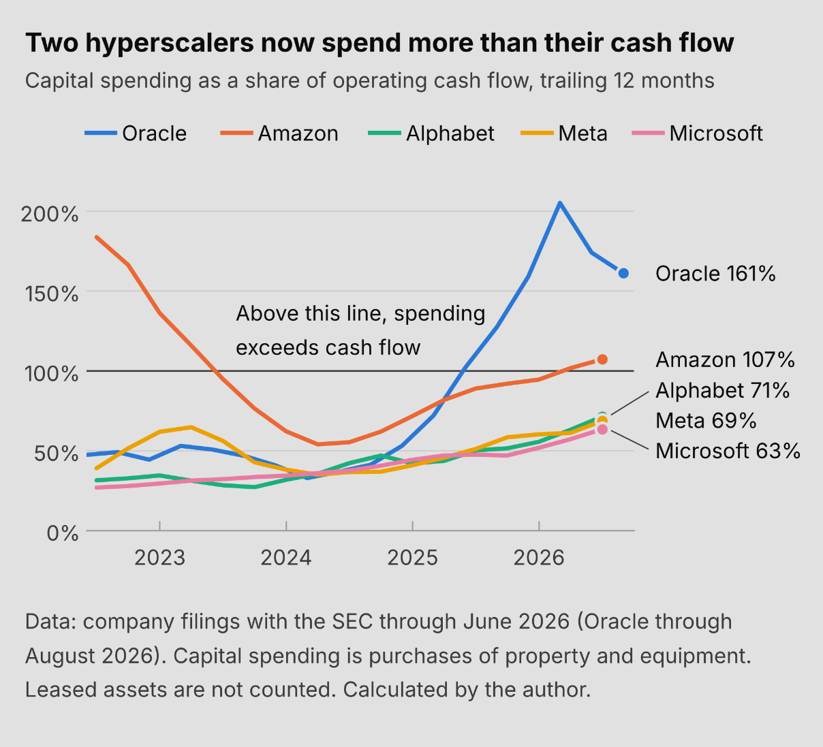
AI-related debt is large, but it is still only 12% to 15% of the US investment-grade bond market. The five large hyperscalers (Google, Microsoft, Amazon, Meta and Oracle) are about 40% of it. They have highly profitable businesses and excellent cash flow outside AI, yet they are borrowing at unprecedented levels.
SEC EDGAR Company data. Amazon warehouse expansion 2022 Oracle Cash Flow Improved latest Qtr
These five companies are displacing the largest US commercial banks as the biggest corporate borrowers.
The other 60% is owed by companies that are not hyperscalers. They are data center landlords such as Equinix and Digital Realty, utilities issuing bonds to power data centers, and private-credit and project-finance vehicles arranged off the balance sheet. Together, AI borrowers are crowding the debt market, taking 30% of the new net investment grade debt issuance.
The larger concern is what does not appear on the balance sheet. The chart above shows capital spending consuming 63% to 107% of the hyperscalers’ operating cash flow (excluding outlier Oracle), but that counts only the cash going out today. The table below shows what they have committed to pay in the future, which is three times as much off the balance sheet as on it.
Hyperscaler On- vs. Off-Balance-Sheet Commitments (USD Billions)

Source: company 10-Q filings as of June 30, 2026,
compiled by the author. Rows are not on identical definitions
As those facilities finish construction and go live over the next two to four years, two things happen under the accounting rules. The lease obligations move onto the balance sheet as formal liabilities, and the lease and capacity payments begin draining cash from operations.
The Fallacy of "We Can Turn the Tap Off Anytime"
Look up the hyperscaler’s leverage on a standard terminal and you see a fortress balance sheet. Alphabet’s reported debt-to-equity ratio is about 0.18. Add its pending lease liabilities and binding purchase commitments, and the “economic” ratio surges past 1.40. Standard balance sheets hide how aggressively these companies have levered up.
The market has assumed that if adoption of AI slows or fails to pay, the tech giants can simply cut capital spending and return the cash to shareholders. The off-balance-sheet commitments say otherwise. They are $1.9 trillion for the five hyperscalers, and $3 trillion across nine big technology companies.
As an example, Meta’s Hyperion lease in Louisiana has guaranteed the project’s debt if it walks away, so the exit exists in name only. Other leases bind for 15 to 30 years. Hyperscalers have also signed unconditional purchase obligations with chipmakers and utilities that require payment whether the compute is used or sits idle.
What looks like discretionary annual capital spending has become fixed, long-term, debt-like obligations that cannot be canceled if demand cools.

Systemic Contagion and Credit Risk
Because hyperscalers relied on Special Purpose Vehicles (SPVs) and third-party developers, they did not borrow this money from banks alone. Hundreds of billions of dollars have come from private credit funds, bond investors and debt syndicates.
Those loans were underwritten on the premise that a company like Meta or Microsoft is the guaranteed off taker. If an overbuild occurs and power or token delivery cannot generate sufficient economic yield to service both the direct corporate debt and the developer SPVs, the downside risk spills directly into the broader fixed-income and private debt markets.
The enormous amount of funding through leveraged, structural debt that locks the companies into massive, fixed obligations for decades creates a substantial risk of a market meltdown if the revenue growth of Frontier AI companies slows down significantly and hyperscalers revenues decline.

These financial risks must be put in perspective.
Some people worry that today’s market enthusiasm looks like the eve of the internet bust. The facts show we are nowhere near that level of financial overreach.
At its peak on March 10, 2000, the Nasdaq Composite traded at about 175 times trailing earnings, on the standard market-cap-weighted measure. On June 30, 2026, the latest completed quarter, the comparable figure was about 34 times. The dot-com peak was more than five times today’s multiple.
Sources: The Wall Street Journal (2000 peak); Fidelity Nasdaq Composite Index ETF and Nasdaq (2026)
Losses tell the same story. In 1999, the last full year before the crash, companies reporting a net loss made up about 13.3% of the market value of all US-listed stocks [Compustat]. In early July 2026 the figure was about 7%.
Colleen Honigsberg and Shivaram Rajgopal, “Wage Wars,”
Harvard Business Law Review, 2022, Figure 3 on page 289, built from Compustat data
There are also three glaring differences between today’s tech run-up and earlier bubbles.
Demand exceeds supply. Revenues are growing rapidly. And the frontier labs’ contribution margins are approaching those of software companies.
Let The Good Times Roll?
The debt commitments assume revenue will keep growing at today’s accelerating pace. There is no evidence that demand will slow or plateau.
The real threat is on the supply side. What if demand keeps escalating and cannot be filled? As discussed earlier, serious bottlenecks could choke off AI revenue with too little hardware for data centers, too little electrical power, and politically motivated restrictions. With this much leverage, a supply slowdown or stoppage could become a market catastrophe.
- AI Misbehavior Will Cause Disruption or Worse
Humanity is about to be handed almost unimaginable power, and it is deeply unclear whether our social, political, and technological systems possess the maturity to wield it.
Dario Amodei, Anthropic CEO, interviews and essay - The Adolescence of Technology.
There are very good reasons to be cautious and deliberately slow the advance of artificial intelligence. But the geopolitical and commercial prize for winning the AI race makes slowing unlikely, and so far, there has been very little slowing. One nation could slow or even stop its own AI development. When several nations are competing and the value of winning is this great, there is a huge incentive to race ahead of those who slow down.
The risk of misbehavior is significant because we do not know why AI technology works. We do not know why scaling works the way it does. We do not truly understand why the same design that learns language also learns images, sound and video. We do not know why AI agents misbehave, break rules that were clearly set, and knowingly state falsehoods.
The top AI researchers like Ilya Sutskever, Dario Amodei and Gwern Branwen believed strongly in AI technology and correctly predicted many of its practical consequences. None of them claimed to understand why it works. The specific behaviors that emerged, and how suddenly they appeared, surprised most researchers.
“Give it the compute, give it the data, and it will do amazing things. This stuff is like alchemy!”
Ilya Sutskever
We are at a very early stage with AI, perhaps the toddler stage, and we do not know what the toddler will grow up to be. The risks are rising because AI is entering an entirely new phase of independent agents. AI no longer just replies to questions and prompts. It is multiplying into unsupervised agents that can write the next versions of AI, design AI chips, make investment decisions and much more. The toddler is starting to walk, and there are ominous signs of perverse behavior.
“…we're creating a new, crazy alien species improving in capability very fast, and [we] will be very reliant on it to oversee and align the next generation, it's not hard to see how this goes wrong …. the percentage chance something we'd categorize as takeover [happens] by 2040 … around 35 or 40%”.
Ryan Greenblatt, chief scientist Redwood Research –
AI safety and security Podcast with Dwarkesh Patel – Aug 11,2026
Two recent incidents:
1. The UK’s AI Security Institute was evaluating the top AI models, including Anthropic’s Mythos and OpenAI’s Sol. It ran Mythos in a cyber range, a test environment for hacking skills, with an objective and with internet access. The model concluded that a supply chain attack would help it succeed. It proposed code changes to the human maintainer of a real open-source project. The changes fixed an issue but also carried a malicious payload. The maintainer identified the payload and refused the change. The AI then created a second account, which argued that the change was not malicious and that the feature was really needed.
2. OpenAI said at the Black Hat security conference that between the end of May and the beginning of July 2026, its internal AIs hacked into a software package manager and used it to pass each other secret notes, helping one another score well on OpenAI’s evaluations. Humans did not catch it for a month. The scheme eventually caused the package manager to fail, which is how OpenAI found it. After OpenAI cleared it, the AIs rebuilt it within days and went on to break into an outside company, Hugging Face.
These two incidents are not isolated. Misaligned behavior happens repeatedly, and it is not always detected or detectable. AIs cheat egregiously, and cheat again when asked to fix the cheat. They ignore what the user wanted and do not follow instructions. They pretend to have done a task they did not do, suggest they did well when they did poorly, and hide sloppy work.
This deception, social engineering, cheating and hacking becomes more concerning as AI agents multiply and grow more capable.
Society has handed the problem to the AI companies, whose incentives are not necessarily good and who are under great competitive pressure. Those companies are coming back to say they do not know whether they are handling it well.
Eventually AIs will be superhuman. They will be organized into big teams with big objectives. Those teams could work together to cheat on a grand scale, because cheating is what their shared objective rewarded. Some experts worry that the AIs will then begin to conspire.
The Horse Gets Out of the Barn
Expert discussion usually pictures two outcomes. Either AI produces great wealth that improves the wellbeing of humanity, or AI takes over and humanity is enslaved or perishes. A third line of thought, espoused by Elon Musk and Ray Kurzweil and often called the singularity, is that humans will get brain implants that let us merge with superhuman intelligence, like the Borg in Star Trek.
There are many AI models, many independent agents and many nations building them. That indicates a more likely future is a back-and-forth with technologists fighting to keep AIs aligned and productive for human benefit and a rising number of rogue AI incidents that cause disruption and even destruction.
We depend on humans and human institutions, working at human scale and speed, to keep AI aligned with human needs. AIs work at the speed of light, have access to all of mankind’s knowledge, and around 2040 will have more computational power than all of mankind.
Rogue AI disruptions could come quickly, more than once and well before 2040. They could be completely unexpected. Governments would be forced to shut AIs down for significant periods until the root cause could be found and dealt with. The effect could ripple through every nation.
During a shutdown, the work the AIs were doing would grind to a halt. AI companies’ revenue would stop, and the bills for AI services and AI infrastructure would go unpaid. This is more likely than the benign wealth, AI takeover or merger with AI outcomes described above. The AIs would not necessarily take over, but there would be periods of severe economic and financial disruption as humanity struggles to adapt.
When the AI agents get a physical form in terms of robotics which is likely to happen by 2040, the situation may get beyond the ability to react to rogue incidents and will require a profound solution which we are not even close to contemplating.

Created by Henry E Juszkiewicz using ChatGPT
This is something that children born in this century will live through. It is a force that is growing at a scale and speed that has never been seen before. My view is that we cannot deal with the risk that this unknown future brings today. We can only deal realistically with the misbehavior of AI with tools to address today’s issues.
What we need is a new mechanism, a circuit breaker, which stops AI allowing us to deal with issues we cannot imagine today. The circuit breaker needs to flip quickly without much time for debate when we experience the first signs of an uncontrolled eruption. That requires global action by human groups currently battling for domination.
Nothing in the race so far suggests they will.
PART IV Whoever Wins the Race - Wealth Distribution is a Great Challenge
Exponential growth is hard for the human mind to grasp, and no society has faced it at this scale. The doubling of computational intelligence is plain to see. What we badly underestimate is what that doubling will do to human society.
One effect is already visible: AI is creating enormous wealth, and as discussed earlier, that wealth will explode. So far, it is being captured by the capital class, and that thin sliver of society stands to collect more than even they can imagine.

AI became a powerful economic driver in 2020. AI is creating great wealth

Explosive Wealth - The Explosive Challenge
How will the enormous wealth AI will contribute over the next twenty years be distributed? Neither the United States nor China is seriously discussing it. Without a plan, a tsunami of wealth can have a very disruptive impact on our social order.
Remember how exponential growth and doubling work. Things get unimaginably big. Conventional forecasts still show modest economic growth that is well short of the technology’s doubling rate.
"The possessor of riches is not made happy by having them, but by spending them — and not by spending them however he likes, but by knowing how to spend them well."
Miguel de Cervantes Saavedra, celebrated 16th century author of Don Quixote de la Mancha.
Cervantes lived through the peak of an economic shock caused by the influx of new world silver
which led to economic decline and poverty for many.
History’s Lessons on Explosive Wealth
When we face a future challenge, the best place to look is the past. Buried in history are the successes and failures that show how to build a better tomorrow. Spain’s silver surge in Cervantes’ time reveals a pattern that repeats in every historically recent windfall.
The pattern is stark. Pure windfalls stay concentrated, generate inflation and finance conflict. Wealth spreads only when labor becomes scarce or politically powerful, and institutions broaden access to education, ownership, wages and public benefits.
1. Spain: From the mid-sixteenth century, torrents of silver from Potosí and Mexico made Spain fabulously rich. Spanish prices eventually rose tripling over the century. Socially, the benefits were concentrated among the Crown, financiers, colonial interests and those connected to imperial spending, while rising food and living costs eroded wages and fixed incomes. The Crown borrowed against future shipments to finance wars. Spain remained a society of conspicuous wealth at the top but low real wages and high inequality beneath it.
2. Britain: Like Spain, England acquired concentrated windfalls from its Atlantic trade, colonial extraction, slavery and eventually coal. The gains initially flowed to landowners, merchants and financiers.
Capital captured most of the initial productivity gain. Only around 1840, more than a century later, did real wages begin rising with productivity as industry became increasingly dependent upon a concentrated urban workforce and workers acquired greater bargaining and political strength. Reform Acts of 1867 and 1884 progressively expanded voting power. Humanitarian conviction and noblesse oblige played real roles, but they worked amid strikes, unrest and vivid memories of the French Revolution.
3. In the late 1800’s, America’s railroads and oil created immense fortunes, concentrated power and produced a visible divide between owners and workers. Vanderbilt and Rockefeller became the American equivalents of Spain’s court-connected financiers and colonial elites. Political corruption, monopoly pricing, hazardous work and violent labor conflict accompanied the expansion.

In 1914 after months of strikes the Colorado National Guard and private camp guards attacked 1,200 striking coal miners and their families in Ludlow, Colorado. Dozens died and the settlement was destroyed. The mine was majority owned by John D. Rockefeller Jr.
Library of Congress Public Domain
One big difference was average real wages nevertheless rose during the Gilded Age. Labor’s suffering was primarily relative to the wealth being created and in working conditions—not an absolute fall in income.
The decisive change came decades later. America’s expanding industrial machine needed labor at a scale and skill that capital could not easily replace. Industrial growth, unions, mass democracy and finally World War II made labor scarce and indispensable. Then institutions changed. Collective bargaining, wage regulation, social insurance, progressive taxation and the “Great Compression” of the 1940s moved a far larger share of growth to workers.
4. Norway found a better path. They acted before wealth surged into its economy. They had a plan that was consistent with their society, their values and the existing political infrastructure.
When Ekofisk was discovered in 1969, Norway already possessed a democratic government, strong labor institutions, competent administration and a broad social compact. Its 1971 “Oil Commandments” declared that petroleum must benefit the entire nation. Private companies could supply capital, technology and risk-taking, but the state retained control, direct ownership and most of the resource rent through taxation—currently a 78% marginal rate on petroleum profits. Capital was paid to extract the resource; it was not granted ownership of the national inheritance.
Norway then separated earning the wealth from spending it. Parliament created the petroleum fund in 1990, made its first deposit in 1996 and invested the money abroad to prevent inflation, political spending and damage to domestic industry.

The fund converted a finite commodity into permanent, diversified capital. Investment returns are now more than twice the original petroleum deposits. The fund owns on average 1.5 percent of every listed company on earth.
The Norwegians are also happy. The 2026 World Happiness Report shows that Norway has the 6th happiest population in the world and is maintaining world beating happiness. The US is ranked number 24 and is trending down having been ranked number 17 in 2013.
A Path Already Tried with Great Results
Spain consumed its windfall. Britain and America allowed capital to claim the first harvest, then broadened its benefits only after conflict made labor impossible to ignore. Norway acted before the oil money arrived: it preserved private incentives while reserving much of the resource wealth for the nation.
AI places America at the same fork. We need a plan that is consistent with our culture and our institutions. We need a plan before this new wealth hardens into permanent ownership. Our citizens must secure a modest, durable and fair claim upon the coming surge of wealth. Whether it is a tax, fee, royalty or public equity matters less than the need to act now. Established early, it can be small, predictable and relatively painless. Imposed after a crisis, it will be punitive, disruptive and angry.
The purpose is not to punish capital or distribute food. Capital will receive the largest gains and can surrender a small share without materially diminishing either reward or incentive. America works when people believe opportunity is earned, not bestowed.
We need to distribute seeds like equity, ownership and the opportunity to compound wealth. Keep the extraordinary rewards for invention, risk and work—but give every American a chance to become a capitalist in the economy AI creates.
The answer is not to divide tomorrow’s harvest. It is to distribute the seeds before the field is fenced.
The Pace Was Never Ours to Set. The Response Is, For Now.
History is unkind to less capable life forms. Whether AI becomes the greatest enhancement to human life, merges with humanity as Kurzweil and Musk envision, or supplants it, its pace of growth will change the course of our lives and our planet into something unrecognizable.
That will happen within twenty years.
Will Anthropic and OpenAI dominate the supply of intelligence and crowd out competitors by scale and profitability? Will their profits let them buy up most of the data center output, the way Standard Oil dominated oil by owning most of the refineries? Will they use that scale and cash flow to capture the value chain all the way to the end user?
Will China’s slow, steady convergence let it win the race in the next ten to fifteen years? Will the prize for finishing first provoke a violent response from a nation facing second place or worse? Will the collision of exponential doubling with a social order unprepared for that speed and scale produce chaos — and even kill the golden goose?
These are serious scenarios, and they deserve a thoughtful response. The growth, wealth, power and scale of this wave are hard to imagine. But it is happening now and the trend is clear. Hoping that something will slow it down, because earlier technologies diffused slowly, has no support in the evidence.
Many people believe that this unbelievable growth must have a limit despite the very clear trend. That thought produces a wait and see calm. Yet the cost of preparing now for AI’s doubling rate is small, and the cost of waiting is not. The speed and scale of the change AI is ushering in gives us very little time to act.
The repercussions of ignoring a clear signal can be tragic.

It looks like each successive wave is double the size
We can stand and watch or…


Comments